Problems tagged with "symmetric matrices"
Problem #043
Tags: linear algebra, quiz-03, symmetric matrices, eigenvectors, lecture-04, linear transformations
The figure below shows a linear transformation \(\vec{f}\) applied to points on the unit circle. Each arrow shows the direction and relative magnitude of \(\vec{f}(\vec{x})\) for a point \(\vec{x}\) on the circle.
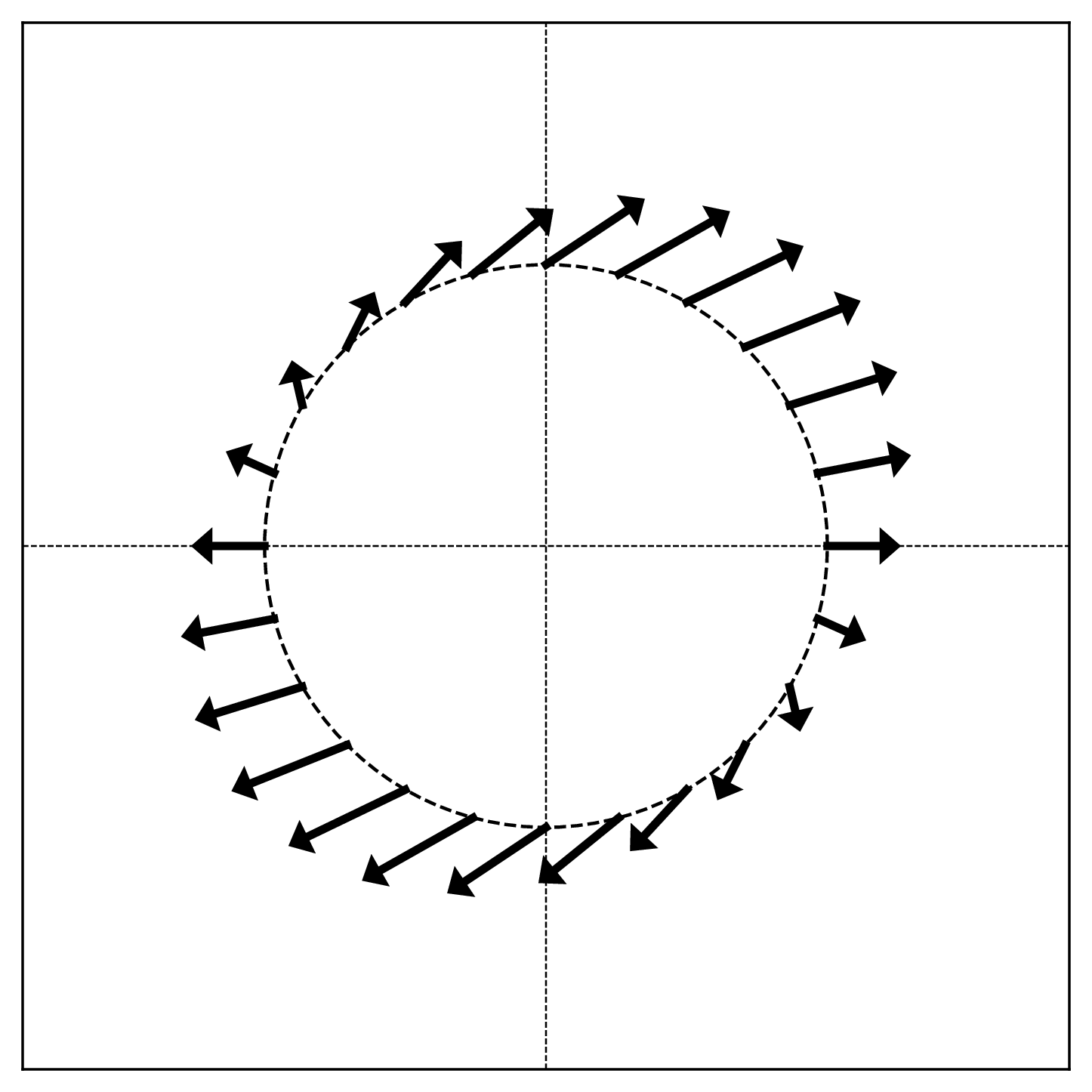
True or False: The linear transformation \(\vec{f}\) is symmetric.
Solution
False.
Recall from lecture that symmetric linear transformations have orthogonal axes of symmetry. In the visualization, this would appear as two perpendicular directions where the arrows point directly outward (or inward) from the circle.
In this figure, there are no such orthogonal axes of symmetry. The pattern of arrows does not exhibit the characteristic symmetry of a symmetric transformation.
Problem #056
Tags: linear algebra, quiz-03, symmetric matrices, spectral theorem, eigenvalues, eigenvectors, lecture-05
Find a symmetric \(2 \times 2\) matrix \(A\) whose eigenvectors are \(\hat{u}^{(1)} = \frac{1}{\sqrt{5}}(1, 2)^T\) with eigenvalue \(6\) and \(\hat{u}^{(2)} = \frac{1}{\sqrt{5}}(2, -1)^T\) with eigenvalue \(1\).
Solution
\(A = \begin{pmatrix} 2 & 2 \\ 2 & 5 \end{pmatrix}\).
We saw in lecture that a symmetric matrix \(A\) can be written as \(A = U^T \Lambda U\), where \(U\) is the matrix whose rows are the eigenvectors of \(A\) and \(\Lambda\) is the diagonal matrix of eigenvalues.
This means that if we know the eigenvectors and eigenvalues of a symmetric matrix, we can "work backwards" to find the matrix itself.
In this case:
Therefore:
Problem #057
Tags: linear algebra, quiz-03, symmetric matrices, spectral theorem, eigenvalues, eigenvectors, lecture-05
Find a symmetric \(3 \times 3\) matrix \(A\) whose eigenvectors are \(\hat{u}^{(1)} = \frac{1}{3}(1, 2, 2)^T\) with eigenvalue \(9\), \(\hat{u}^{(2)} = \frac{1}{3}(2, 1, -2)^T\) with eigenvalue \(18\), and \(\hat{u}^{(3)} = \frac{1}{3}(2, -2, 1)^T\) with eigenvalue \(-9\).
Solution
\(A = \begin{pmatrix} 5 & 10 & -8 \\ 10 & 2 & 2 \\ -8 & 2 & 11 \end{pmatrix}\).
We saw in lecture that a symmetric matrix \(A\) can be written as \(A = U^T \Lambda U\), where \(U\) is the matrix whose rows are the eigenvectors of \(A\) and \(\Lambda\) is the diagonal matrix of eigenvalues.
In this case:
Therefore:
Problem #099
Tags: symmetric matrices, laplacian eigenmaps, quiz-05, lecture-08
True or False: Given a symmetric similarity matrix \(W\), the Graph Laplacian matrix \(L\) will always be symmetric.
Solution
True.
Since \(D\) is a diagonal matrix (and therefore symmetric), and \(W\) is symmetric by assumption, the Graph Laplacian \(L = D - W\) is the difference of two symmetric matrices, which is always symmetric.